Stamping and stamp making, Woodcut
POL,
Horyniec-Zdrój
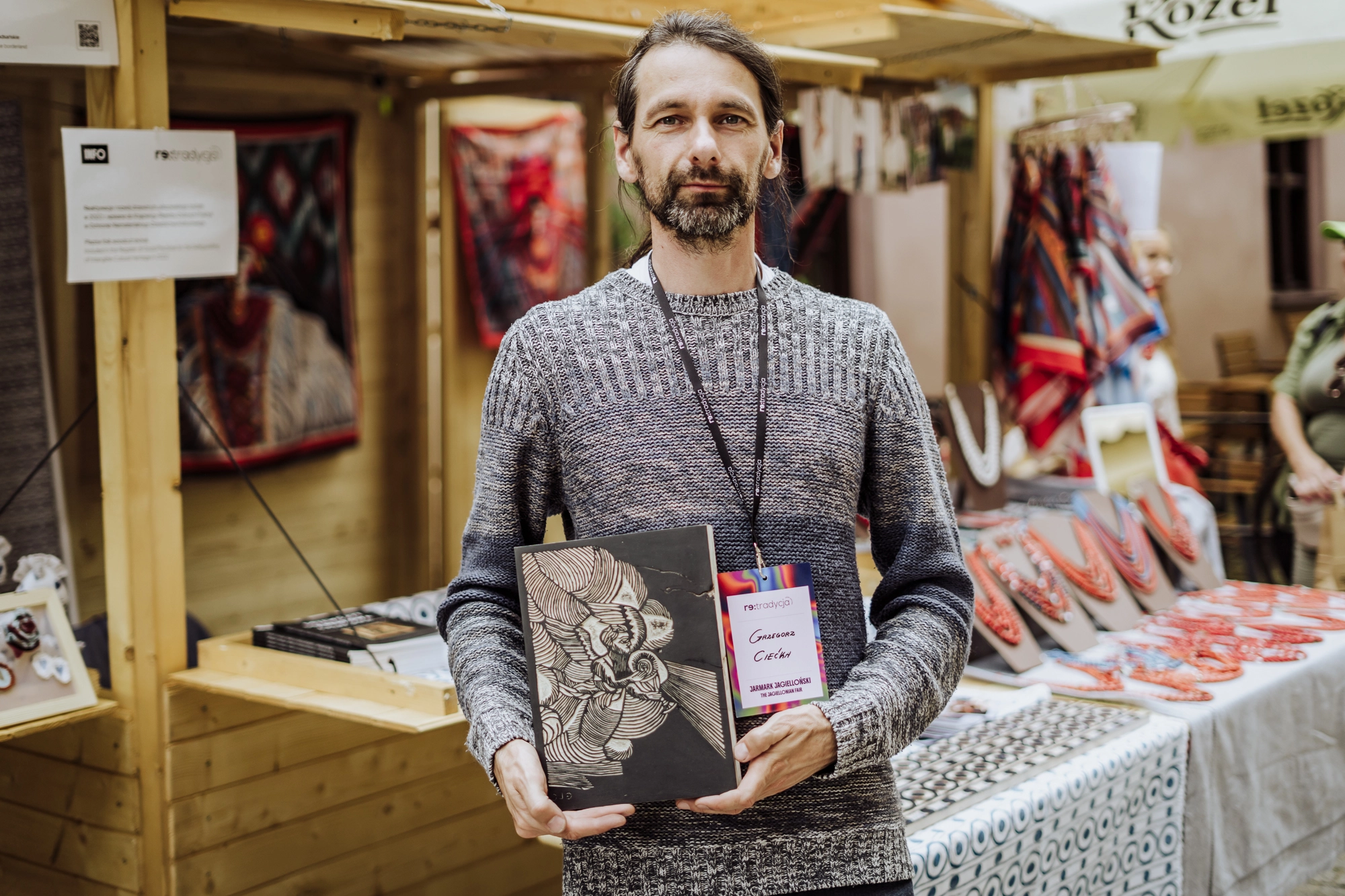
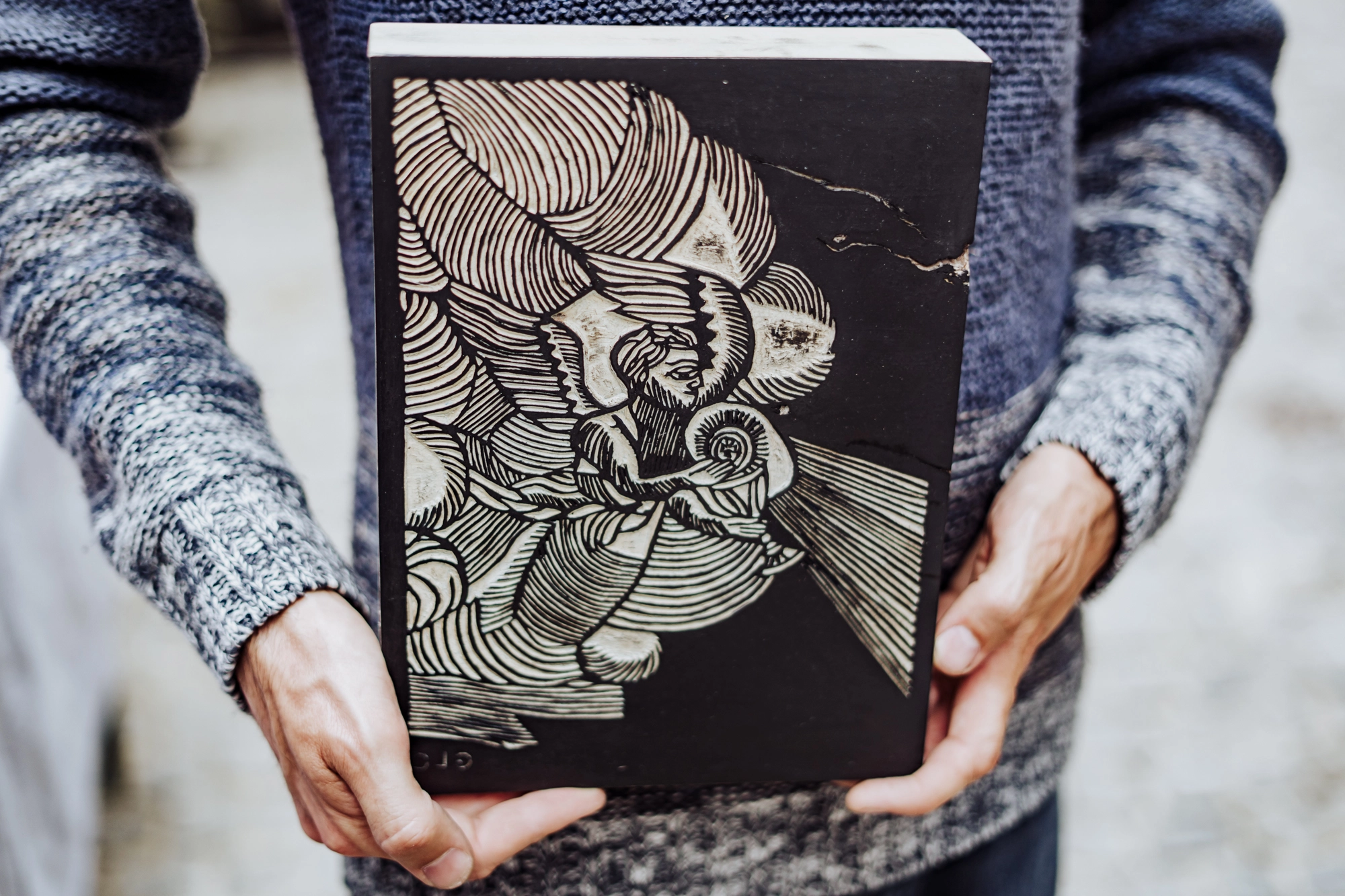
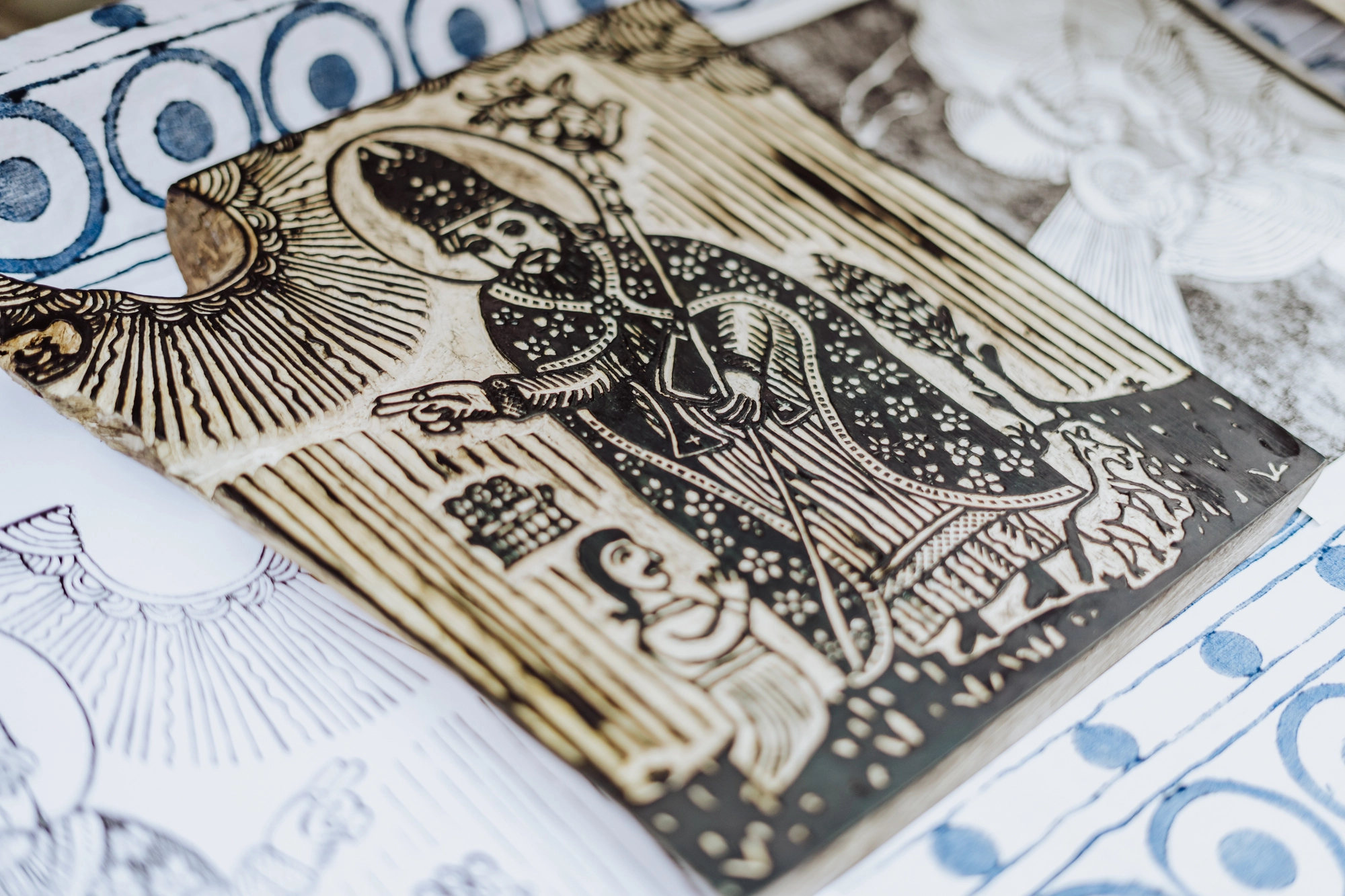
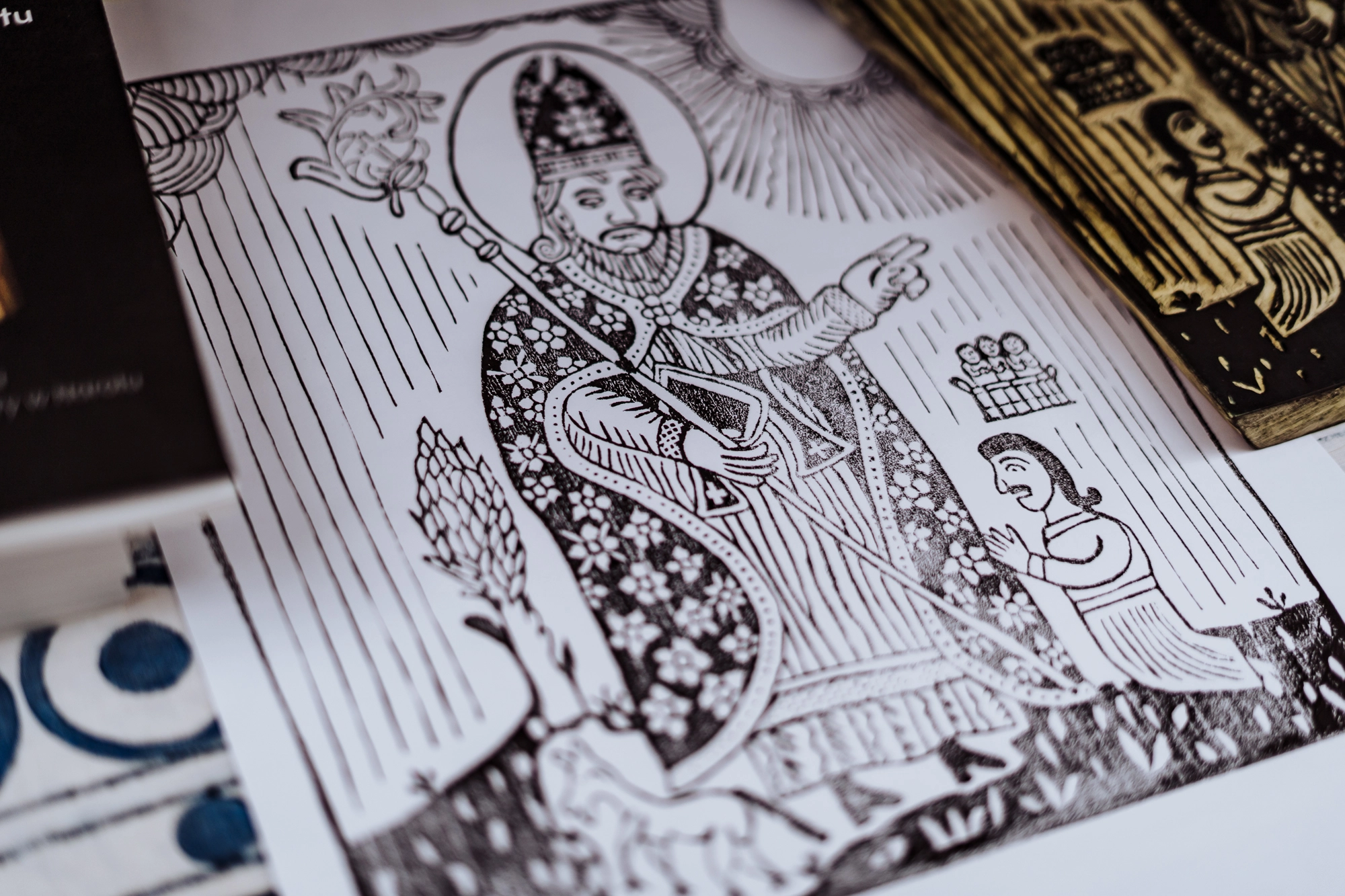
Mr. Grzegorz Ciećka specializes in woodcut printing and hand-printing on fabric. His work centers on the meticulous reconstruction of historic regional patterns, alongside original motifs inspired by traditional designs. Using a simple knife, he carves his matrices from linden wood. For paper prints, he employs traditional oil-based inks, while for textiles, he uses pigments of lampblack and ultramarine mixed with a linseed oil base.
Mr. Grzegorz comes from a family with a multi-generational history of carpentry, timber framing, and woodworking. Both his maternal grandfather and uncle, as well as his paternal grandfather – who was locally renowned for crafting horse-drawn sleighs – owned carpentry workshops. Mr. Grzegorz’s father was a carpenter. Another significant family figure was his grandfather’s cousin, Mieczysław Zaborniak, known as the “last stonemason of Stare Brusno”. He influenced Mr. Grzegorz’s interest in history and stone sculpture.
„My journey with woodcut printing began long before I consciously took it up. I come from a family that has worked with wood for at least five generations. As a child, I observed this work up close, helped with small tasks, and absorbed the mindset regarding materials and tools. That was when – unconsciously – my initial interest emerged, eventually evolving into a dedicated creative path. I had heard since childhood that people in our family possessed artistic talent. A prime example was my uncle, who worked as a Carpenter”. Family traditions transformed his passion into concrete action, particularly regarding the art of woodcut printing. As he himself puts it: „Most of my family was connected to the Płazów parish or its immediate vicinity. My interest in Płazów woodcuts began with a collaboration with the Ethnographic Museum in Kraków in 2016, when the Folkowisko Festival launched an initiative to promote this intangible cultural heritage within the Lubaczów County. Since 2020, efforts have also been underway to mobilize the local community around the idea of reviving the woodcut tradition”.
Józef Lewkowicz, a local folk artist from Nowe Sioło, was among those invited to join the initiative group – organized by members of the Tegit Et Protegit Association – dedicated to promoting Płazów woodcuts. The work of individuals such as Marek “Prus” Głowacki and Tadeusz Grajpel also served as a catalyst for organizing activities centered on folk woodcut art.
The collaboration established with local artists at that time resulted in the tradition’s inclusion in the National Register of Good Practices for the Safeguarding of Intangible Cultural Heritage. Furthermore, the revival of woodcut traditions led to the re-establishment of the tradition of printing on canvas. Mr. Grzegorz continues to explore and develop both of these fields, supported by scholarships awarded by the National Institute of Rural Heritage and Culture and the Ministry of Culture and National Heritage.
Mr. Grzegorz speaks about the ongoing efforts to sustain these local traditions:
„Today, I realize just how important that moment of passing on knowledge was – the presence of the elders, their patience, and the natural way a child was included in the work. That is why I very consciously open my workshop to younger generations. During woodcut workshops, children and young people not only learn the technique but, above all, experience the entire proces – from a raw piece of wood to the finished print.
Often, it is the youngest participants who bring freshness and boldness to the work. Their perspective is not yet constrained by conventions, allowing them to ask simple yet insightful questions and propose solutions that an adult might not think of. Working together on the woodblock or the print thus becomes not just a lesson in craftsmanship, but also an intergenerational dialogue.
I am convinced that if the Płazów woodcut tradition is to survive, it must be through this very method – direct contact, collaborative work, and the natural passing down of skills, just as it happened in the past. That is why every child who picks up a tool and tries their hand at it represents, to me, a genuine continuation of this tradition”.
The artist is a member of the Tegit et Protegit Association and the Folkowisko Borderland Culture Animation Association, where he serves as vice-president. At Mr. Grzegorz’s stand, one can find woodcut prints on paper as well as fabrics featuring printed patterns.
Płazów folk woodcut revival included in the Poland’s National Register of Good Practices for the Safeguarding of Intangible Cultural Heritage in 2022.
Contact
www: drzeworyt.ziemialubaczowska.pl
e-mail: drzeworytnia@gmail.com