About
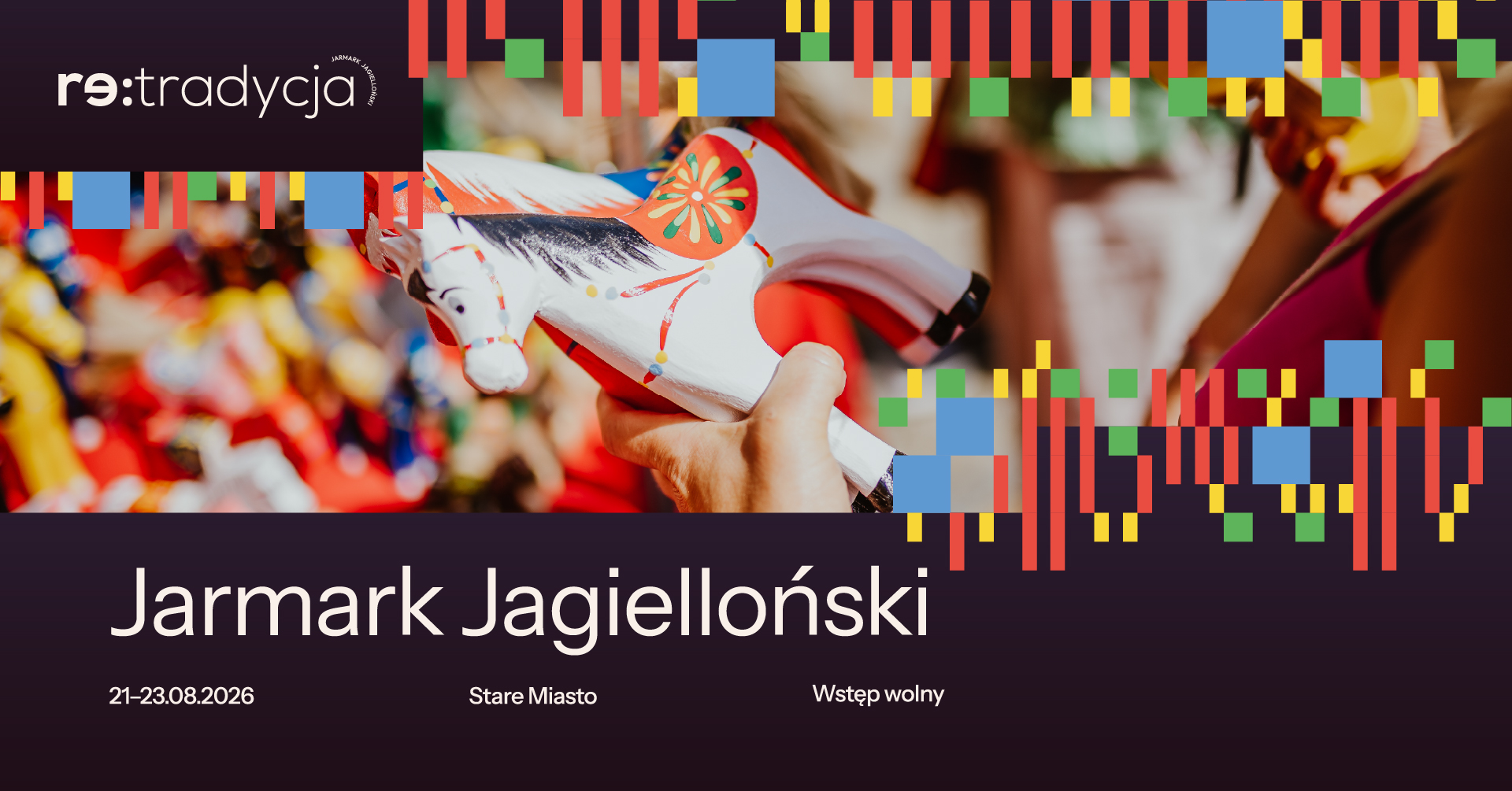
The Re:tradition – Jagiellonian Fair festival will take place in Lublin this coming weekend (August 21-23). Once again, the Old Town will welcome masters and mistresses of traditional crafts and folk art, for whom tradition is a major source of inspiration. During this year’s celebration of traditional culture, around 130 craftspeople from Poland, Lithuania, Ukraine, Slovakia, the Czech Republic, Hungary, Romania, and even India will present their work. Nearly 40 of them continue traditions inscribed on national lists of intangible cultural heritage.
The people we invite continue many diverse traditions rooted in the heritage of rural communities. These include ceramics, painting, wickerwork, ritual and decorative art, jewellery, blacksmithing, sculpture, instrument making, weaving, and woodworking. Since childhood is the main theme of this year’s Festival, we want to pay particular attention to the craftspeople who make toys. Let’s get to know them and their work.
Colourful wooden birds
The work of Bogumiła Leśniak, Piotr Mentel, and Danuta Sałaciak can be found not only at their festival stalls, but also on an artistic installation – a pająk – traditional chandelier-like decorative mobile that will appear at Krakowska Gate for the duration of our event.
Bogumiła Leśniak (POL) is a sculptor. The tradition of folk art in her family goes back several generations. Her grandmother made wooden dolls, while her mother worked at the Spółdzielnia Rzemieślnicza in Sucha Beskidzka. As she herself explains:
In 1984, after getting married and moving to Stryszawa, my adventure with Stryszawa birds began. My father-in-law Emil Leśniak, his brother Edward, and my mother-in-law Genowefa carved and painted Stryszawa birds. I learned from them how to make these small sculptures: chopping wooden blocks, carving them with a knife, preparing them on wires, painting them, and creating compositions known as “families” on branches or small boards.
That is why, alongside sacred and secular sculptures and bas-reliefs, the artist’s stall will also feature colourful wooden birds inspired by traditional local patterns and, at times, by the natural colouring of different bird species.
The multigenerational tradition of making toys and Stryszawa birds is also continued by Piotr Mentel (POL). The emergence of the now-famous Stryszawa birds can be traced back to Teofil Mentel (1876-1944), one of Mr Mentel’s ancestors. His grandparents, Stefania (1923-2005) and Julian (1923-1995), as well as his parents, Antonina (1958) and Tadeusz (1955-2005), also contributed to Piotr acquiring, from an early age, the skills needed to make wooden toys inspired by local traditions. Today, just as his ancestors once did, he makes colourful birds, horses and carriages, merry-go-rounds, klepoki, and nativity scenes. His children, Natalia, Zuzia, and Miłosz, also join him in his work and at fairs.
Danuta Sałaciak (POL) is another artist from Stryszawa who continues the toy-making traditions popular in the region. From an early age, she learned from her grandparents and parents, who passed their skills on to her, and at the age of 20 she began carving independently. Today, her two children help her with her work. Ms Sałaciak carves the shape of a toy from pine or lime wood using a knife and then paints it by hand. She inherited the patterns she uses from her parents, while developing some of them herself, inspired by nature. Her stall will feature a variety of bird sculptures – large and small, perched on wires and bushes, or sitting in nests.
Diverse toy-making centres in Poland
Wiesława and Marian Łoboz (POL) also make toys rooted in the traditions of the Beskid Żywiecki region. Pewel Wielka, where they come from, is one of the region’s important toy-making centres. Mr Łoboz learned the craft at his family home, Ms Łoboz acquired these skills from his parents, and over time their sons joined them as well. As Mr Łoboz says:
My grandfather, father, mother, and older brother made folk toys alongside running the farm. I did the lighter work – whatever I was able to do. The older I got, the more independent my work became. After many years, I can say that they were my masters.
At the artists’ stall, you will find horses on wheels and rocking horses, klepoki birds, ladder wagons and carriages, merry-go-rounds, animal figures, pipes and whistles, as well as their most distinctive creations, which they came up with themselves – winged horses, or pegasi.
Ryszard Marciniec (POL) makes traditional wooden toys. He comes from Brzóza Stadnicka in the Podkarpackie region, which was once a well-known toy-making centre. As he himself explains:
As a young boy, I helped my father, Stanisław, in his workshop. I would sit and watch, hand him tools, and later I started making toys myself. At the age of 14, with my own hands but under my father’s watchful eye, I made a car, a box truck. Today, some of the patterns I make are things I inherited from my father, while I came up with others myself.
Mr Marciniec mainly works with old, traditional patterns, which is why his stall at the Jagiellonian Fair will feature, among other things, klepoki, pecking hens, horses, pop guns, and wheelbarrows.
Non-toys
One artist who creates toys and non-toys and draws inspiration from tradition in his work is Piotr Rogaliński (POL). For 30 years, he has worked at the intersection of theatre, music, and visual art. He creates “sculpture-toys” and props for carolling performances. Drawing on old patterns, he also makes decorations and sets for concerts and performances. He creates his work by hand, mainly in wood, leaving the material raw or colouring it with earth or wax. His sculptures are inspired by old patterns borrowed from other artists or found in archival materials.
Mr Rogaliński is also working on a sculptural project entitled “Non-toys”, in which he seeks to give folk toys new meaning by placing them in new contexts. The aim is for them to become a living and contemporary means of artistic expression, allowing the potential hidden in folk toys to be used in dialogue with the present day and to address important issues affecting adults. In addition to sculptures and props, he also makes accessories for drummers, such as sticks, wires, triangles-stalks, and brass rattles.
During the Festival, alongside visiting Mr Rogaliński’s stall, we also invite you to the exhibition “Non-toys, tree of life”, where the artist presents his work. The exhibition is open at the Gardzienice Gallery (Grodzka 5a) on Friday from 13.00-19.00, and on Saturday and Sunday from 11.00-19.00.
Exhibition | Non-Toys, Tree of Life | Piotr Rogaliński (POL)
When:
August 21 (Friday), 13:00-19:00
August 22-23 (Saturday-Sunday), 11:00-19:00
Opening: August 21 (Friday), 18:00
Where: Gardzienice Gallery, Grodzka 5a, 1st floor
Admission free
The art of toy making beyond Poland
Dmytro Kudria (UKR) grew up in an environment where working with wood was part of everyday life. His grandfather repaired violins, while his father made windows and doors. Mr Kudria graduated from the Music School in Kropyvnytskyi (wind instrument class), but his childhood passion for wood influenced his choice of career. Today, Mr Kudria is a renowned craftsperson and educator. Delicate shapes, the natural colour of wood, and carved ornaments can be found both in his toys and, for example, in his simple instruments. The sound of the latter draws the attention of everyone in the vicinity of Mr Dmytro’s stall.
Serhiy Sviatnyi (UKR) is also a maker of wooden toys and simple instruments. From 1980 onwards, he learned from masters from his region, including Oleksandr Kolosha, Anatoliy Kaloshyn, and Anatoliy Ivaankov. Today, his hands produce rattles, clappers, horses, and birds whose patterns draw on Chernihiv traditions. All of the artist’s work retains the natural colour of the wood, giving it a unique charm. During the Festival, visitors will be able to try playing melodies on instruments made by the artist and purchase them.
These are, of course, only a few of the craftspeople you will meet during the Jagiellonian Fair. There are many more stalls to explore, featuring craftspeople from Poland, Ukraine, the Czech Republic, Slovakia, Lithuania, Hungary, Romania, and India. Their full list can be found on our website.
The craftspeople will be available at the Old Town from Friday from 13.00-18.00, and on Saturday and Sunday from 10.00-18.00.
Details
When:
August 21 (Friday), 13:00-18:00
August 22-23 (Saturday-Sunday), 10:00-18:00
Where: Old Town and Śródmieście
Admission free
Accessibility
Walk around the Fair with Polish Sign Language interpreters
During the festival, people who use Polish Sign Language will be able to join interpreter-guides for a walk around the Jagiellonian Fair. Polish Sign Language interpreter duty hours have been scheduled, and interpreters will be available at the festival information point at Łokietka Square.
Interpreter duty hours:
August 21 (Friday), 16:00-18:00
August 22 (Saturday), 14:00-18:00
August 23 (Sunday), 11:00-14:00
People using Polish Sign Language will be able to visit selected craftspeople together with an interpreter, ask about their work, products, and traditions, and of course take the opportunity to purchase unique folk art items.
Interpreters: Jolanta Gromada and Łukasz Grzesiuk
About the Re:tradition – Jagiellonian Fair festival
Re:tradition is an extraordinary festival of traditional music and craftsmanship. During three August days and nights, Lublin transforms into the capital of living traditional culture.
The festival program offers a wide range of attractions for both children and adults. It provides a unique opportunity to meet master artisans who, each year, showcase their exceptional handmade creations. Traditional music is also a key element of the Re:tradition festival, presented both in its authentic form and through the interpretations of contemporary artists.
The festival also features evening dance parties with live music, workshops, exhibitions, performances, film screenings, and meetings. Younger visitors can enjoy the Re:tradition Playground, where traditional games and pastimes are brought back to life.
The festival allows visitors to hear, see, touch, and experience folk culture, which during this time completely fills the streets of Lublin’s Old Town.
Details
Re:tradition – the Jagiellonian Fair
August 21-23, 2026
Lublin, Old Town
Admission to the event is free.
Organisers: Workshops of Culture in Lublin, Cultural Institution of the City of Lublin, Lublin City of Inspiration
Honorary Patronage: Krzysztof Żuk, Mayor of the City of Lublin; the National Heritage Institute
Patron: Ministry of Culture and National Heritage
Media Partners: TVP Kultura, TVP3 Lublin, TVP ABC, Program II of Polskie Radio, Polskie Radio Dzieciom, Radiowe Centrum Kultury Ludowej, Radio Lublin, Gazeta Wyborcza, Weranda Country, KulturaLudowa.pl, MuzykaTradycyjna.pl, Kultura Enter, ONET
Partners: Lublin Airport, Kultura Enter Foundation, Gardzienice Centre for Theatre Practices, Old Theatre in Lublin, Dominicans of Lublin, the National Museum in Lublin, Ivan Honchar Museum, the Association of Folk Artists
Co-financed by the Ministry of Culture and National Heritage of the Republic of Poland from the Culture Promotion Fund.