About the events
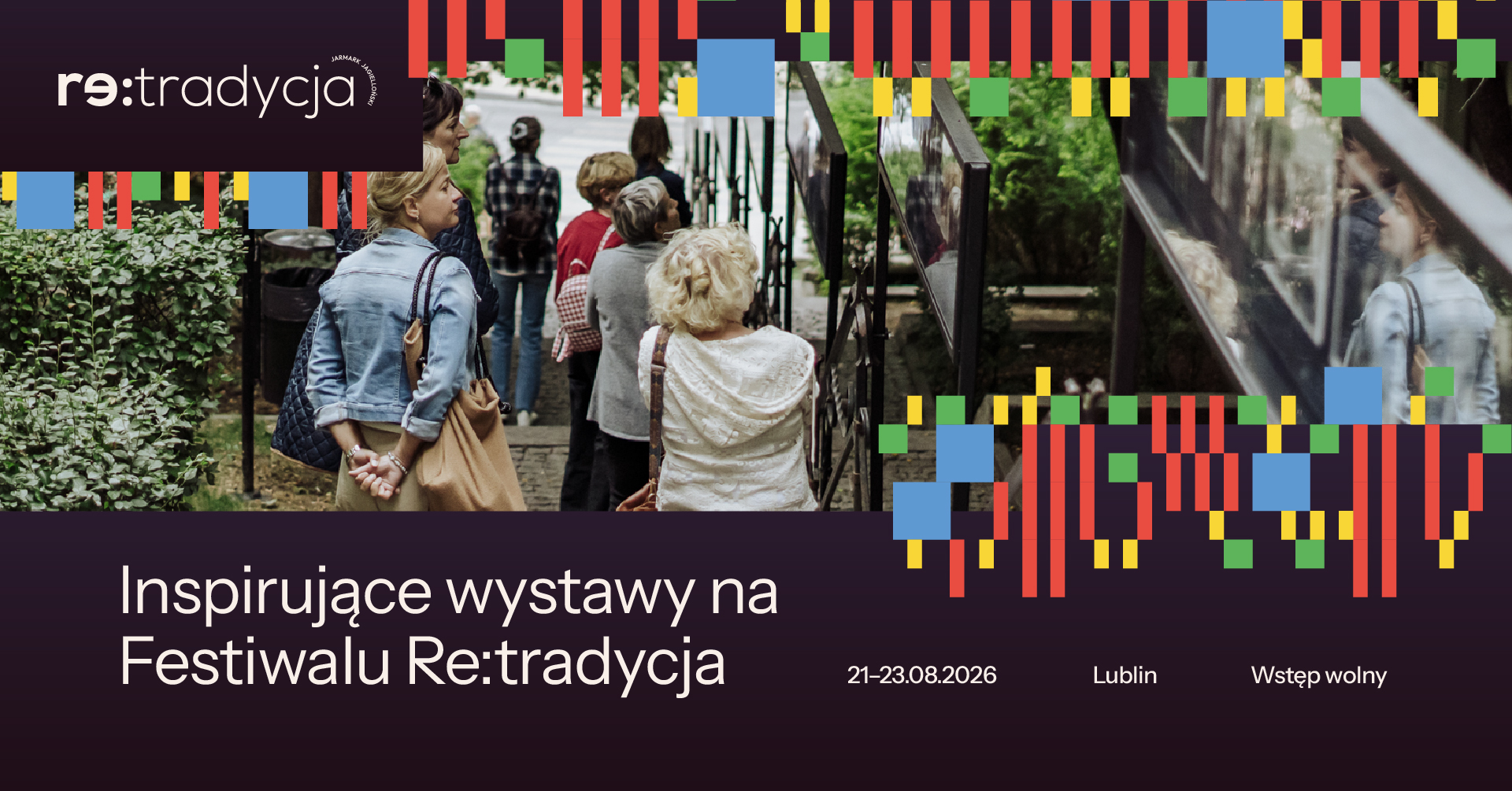
The Re:tradition – Jagiellonian Fair festival (21-23 August, Lublin) is about much more than music, concerts and presentations of folk art. It also features exhibitions that create a space for encounters with art inspired by tradition – from photography, sculpture and woodcuts to double-weave textiles and illustrations.
As is now tradition, the Krakowska Gate will be decorated with a huge pająk – traditional chandelier-like decorative mobile, this time filled with colourful birds associated with Stryszawa in the Beskids, known as the capital of Polish folk toy-making. Almost all of the exhibitions will relate to this year’s main theme: childhood. Admission to all exhibitions is free.
Children of Średnia Wieś Through the Lens of Jukka Male | Jukka Male (FIN) | Summer School of Tradition
Jukka Male is a Finnish photographic artist who first came to the village of Średnia Wieś, located in the Bieszczady Mountains in southern Poland, in 1979. For 36 years, he kept returning to the same places and people, documenting their lives and the changes they experienced. The villagers welcomed him warmly, and over time he earned their trust and friendship. Jukka Male photographed everyday life, family celebrations, work, and leisure. Thanks to his long-term documentation, we can witness these transformations – children seen in his black-and-white photographs later reappear as teenagers in colour images taken in the “new Poland.”
The selection of works presented in the exhibition focuses primarily on children, whose lives Jukka Male portrayed as they truly were – without unnecessary staging or idealisation. We see them playing, working, and resting. They are full of the simple joy of being together and having fun, while also helping with farm work and supporting their parents and grandparents. We also see the world in which they grew up – the yard, the fields, the family home, and the people closest to them.
The exhibition is presented as part of the “Summer School of Tradition” project.
The Summer School of Tradition is organized by the Kultura Enter Foundation.
The project is implemented with the support of the City of Lublin.
In cooperation with: Workshops of Culture in Lublin, the Re:tradition – Jagiellonian Fair festival, and the Dominican Monastery in Lublin.
Details
When: August 3-28, 2026, open 24 hours a day
Where: Hartwig Alley
Admission free
Art installation | Pająk – traditional chandelier-like decorative mobile | Wojciech Świątkowski, Bogumiła Leśniak, Danuta Sałaciak, Piotr Mentel (POL)
In the year dedicated to the theme of childhood, our art installation – a straw mobile suspended in the Krakowska Gate – will be filled with colourful birds associated with the capital of Polish toy-making, the Beskid village of Stryszawa.
In this village (and many other nearby villages), wooden toys have been made since the second half of the 19th century.
The history of the birds themselves is said to date back to Teofil Mentel from Stryszawa, who in 1888, at the age of 12, became a servant to a hermit from Kalwaria Zebrzydowska. During six years of service, he helped with daily duties, but also carved wooden religious figurines. At the end of his service, he received a colourful atlas of birds as a gift of thanks, which he took home with him. When his parents asked what he had learned, he showed them the book and said that from now on he would make such colourful figurines.
As Kraków ethnographer Tadeusz Seweryn noted, around 1900 Teofil brought an entire basket of birds he had made himself to a fair in Sucha Beskidzka. This encouraged his brothers to take up the craft as well and, over the years, influenced the history of later generations of the Mentel family and the entire region.
The birds we will see on the straw mobile were made by folk artists: Danuta Sałaciak, Bogumiła Leśniak, and Piotr Mentel.
The impressive wicker nest on which the Stryszawa birds have “landed” is the work of Wojciech Świątkowski, a basket maker from Leszno in Mazovia.
This year’s installation is also a meeting of traditions inscribed on lists of intangible cultural heritage:
- Żywiec-Sucha toy-making was inscribed on the National List of Intangible Cultural Heritage in 2016.
- Basketry in Poland was inscribed on the National List of Intangible Cultural Heritage in 2018.
- Basketry traditions were inscribed on the Representative List of the Intangible Cultural Heritage of Humanity (UNESCO) in 2025.
Details
When: August 21-23 (Friday-Sunday)
Where: Krakowska Gate
Admission free
Listen to the Echo | Kaja Prusinowska (POL)
We invite you to an exhibition of works by Kaja Prusinowska. Romuald Demidenko writes about the artist and her work:
The exhibition presents digitally processed images originally created as watercolours and ink-and-pencil drawings on paper, as well as works drawn with a stylus on a tablet. The expression and lightness of these works, achieved through the use of watercolours and the blurring of colour fields – including those displayed on a liquid crystal screen – lead me to call them “flowing images”. I am not entirely certain, however, whether this term fully captures their character.
Kaja Prusinowska creates covers for music albums and audio productions, as well as animations accompanying concerts and performances, including those created for the Muzykancka Kompania Dziecięca developed together with Janusz Prusinowski. Her images are usually characterised by vivid, intense colours strongly contrasting with their often dark backgrounds. They resemble ornaments or paper cut-outs. They primarily depict the more-than-human world: plants, birds, and other animals. They bring to mind illustrations from fairy tales and old stories, and thus also a childlike way of seeing the world.
A source of inspiration for the artist can be found in childhood illustrations, book covers, and the mysterious worlds created by artists such as Jan Marcin Szancer or Tove Jansson. Another inspiration is the ornamentation of traditional culture and the associations that folk art continues to evoke: embroidery, lace, and paper cut-outs. In these forms, aesthetics intertwined with function, and decoration was an integral part of everyday life rather than an addition to it.
Romuald Demidenko – curator, art historian, and occasional writer. He is interested in representation, accessibility, and relationships between art, environmental humanities, and otherness. Since 2008, he has realised exhibitions, public programmes, and publications in various formats, most recently at the Baltic Gallery of Contemporary Art in Słupsk and Ustka. He is a member of the International Association of Art Critics – AICA.
Details
When: August 21–23, 9:00-17:00
Where: Workshops of Culture, Grodzka 7, entrance gate
Admission free
In Stone and Wood… | Józef Lewkowicz (POL) – accompanying event
We invite you to an exhibition prepared by the festival Partner – Stowarzyszenie Twórców Ludowych.
From June 6 to August 31, the STL Folk Art Gallery presents an exhibition of works by Józef Lewkowicz – a renowned artist from Nowe Sioło, a small village near Płazów (Podkarpackie Voivodeship), who for over 40 years has been fascinated by stone and wood carving, and for some time also by woodcut art. The exhibition presents not only woodcuts, but also stone and wooden sculptures.
Folk artist Józef Lewkowicz is a self-taught sculptor and passionate creator. For many years, he worked primarily in wood, creating various forms typical of folk art, including figures of patron saints, angels, flowers, and multi-figure compositions. Over time, he decided to apply his skills to stone carving, a craft requiring not only talent but also strength and patience. This led to the creation of works stylistically inspired by the tombstone sculpture known from the Bruśnień stone-carving centre. He used stone from local deposits for his work.
Over time, a new passion appeared in the artist’s life – woodcuts. Thanks to his curiosity and research, he discovered 19th-century works originating from the folk woodcut workshop of the Kostrzycki family. Thirteen blocks from that workshop have survived to this day, including nine carved on both sides – a total of 22 woodcuts depicting saints and one floral pattern known as kołtryna.
Józef Lewkowicz decided to recreate the matrices of these forgotten and highly valuable woodcuts. His work resulted in the revival and later popularisation of Płazów woodcuts. In 2022, this phenomenon was entered into the Register of Good Safeguarding Practices of Intangible Cultural Heritage. The entry contributed to the growing popularity of this field of folk art. Workshops, lectures, exhibitions, and competitions began to be organised. During various events, the artist demonstrates the process of creating prints and carving, attracting crowds interested in this technique. Józef Lewkowicz quickly became a leading master and mentor, willingly passing on his knowledge and skills to younger generations, wanting the memory of woodcutting traditions in this region to remain alive.
The artist from Nowe Sioło not only recreates matrices of old woodcuts, but also creates his own original works, which have become part of broader activities promoting the history and culture of the region.
It is worth adding that in the 19th century, images of saints were an important element of rural interior decoration. Often without frames or glass, they were attached to walls or boards above stoves. They were also hung in dowry chests, on bed headboards, and in stables. Saints were believed to protect farms, their inhabitants, and animals. Prints could mainly be purchased at fairs and religious festivals.
Woodcut is the oldest graphic art technique. The first stage of its creation is a drawing transferred onto wooden blocks. A carving knife or chisel is then used to cut away the background and create shading with lines. The print is an impression of the completed matrix.
Organiser: Stowarzyszenie Twórców Ludowych
Curatorial care: Katarzyna Kraczoń
Funded by the Ministry of Culture and National Heritage (MKiDN)
Details
When: June 6 – August 31, 10:00-17:00
Where: STL Folk Art Gallery, Grodzka 14
Admission free
Non-Toys, Tree of Life | Piotr Rogaliński (POL)
For twenty years, Piotr Rogaliński has been working at the intersection of theatre, music, and visual arts. All these paths have led him to create the exhibition presented as part of this year’s Re:tradition festival.
The artist introduces us to the world of his work:
For this exhibition, I have selected mostly works that have not been presented before. I will show sculptures from two series.
The first series, the so-called dark one, continues my earlier works, which tell stories of the hardships of life and serve as an alert for humanity and its actions.
The second, bright series, was created in the form of a tree of life – with scenes referring to harmony, love, tenderness, and delicacy. Just as a tree connects the earth with the sky, so in human beings the earthly meets the spiritual, the tangible meets the fleeting.
In both series, I use images inspired by folk toys: dolls, little birds, horses, flowers, and many others.
Based on old patterns, Piotr Rogaliński creates decorations and set designs for concerts and performances. He specialises in making toy sculptures and figures of carollers, which he uses as props in his theatrical work. As an actor, he co-created performances at Teatr Studio Czyczkowy and Teatr Węgajty. He leads theatre workshops for young people and people with disabilities. He prepares programmes for children devoted to themes connected with folk culture. For several years, he has also played in bands performing traditional music. He is the author of numerous visual arrangements for historical exhibitions and concerts, including those for the Museum of the Poznań Uprising – June 1956. He has collaborated with institutions such as: IPN Poznań, Museum of the Wielkopolska Uprising 1918–1919, Dom Bretanii, Zamek Culture Centre in Poznań, and M. Karłowicz Philharmonic in Szczecin.
Details
When:
August 21 (Friday), 13:00-19:00
August 22-23 (Saturday-Sunday), 11:00-19:00
Opening: August 21 (Friday), 18:00
Where: Gardzienice Gallery, Grodzka 5a, 1st floor
Admission free
“Woven Pixels” and retro games | Karolina Radulska and Atarynka.PL (POL)
We invite you to the exhibition “Woven Pixels” by Karolina Radulska, a folk artist from the Podlaskie region. The exhibition presents a series of six double-warp woven tapestries depicting visual interpretations of games such as Arkanoid, Tank, Pac-Man, Super Mario Bros, Tetris, and Donkey Kong.
Karolina Radulska describes the exhibition:
The inspiration for creating this series was the growing phenomenon of so-called retrogaming – the return to games with simple, pixel-based graphics which, despite technological limitations, offered immense enjoyment and became permanently embedded in popular culture. As a weaver who has worked with double-warp weaving for many years, I treated these old games as a collection of contemporary aesthetic patterns, close to the geometric arrangements and rhythms characteristic of folk textiles.
As part of the project, I created a series of six double-warp woven tapestries depicting characters from classic games such as Pac-Man and Super Mario Bros in a completely new, reinterpreted form – creating a dialogue between an old tradition and the digital imagination of the present day.
“Woven Pixels” connects different eras and generations: those who remember double-warp textiles from their family homes in Podlasie, those for whom video games are a memory of youth, and all those who are only discovering both worlds and finding something meaningful in them.
The exhibition also shows that tradition can be approached in unconventional ways. Building on the great skill and knowledge of a technique inherited from previous generations, it is possible to search for new forms of expression and new ways of communicating elements of one’s identity.
The presentation of six works created by the artist will be complemented by gaming stations prepared by Atarynka.PL – the Lublin Group of Retro Games and Console Enthusiasts. Visitors will be able to try their hand at the games represented in the double-warp woven tapestries.
The textiles were created as part of a scholarship awarded by the Marshal of the Podlaskie Voivodeship in the field of artistic activity.
Details
When: August 21-23 (Friday-Sunday), 13:00-19:00
Where: Workshops of Culture, Grodzka 7, exhibition hall, 2nd floor
Admission free
These are, of course, just a few of the many highlights of this year’s festival. Discover the full programme at retradycja.eu.
About the Re:tradition – Jagiellonian Fair festival
Re:tradition is an extraordinary festival of traditional music and craftsmanship. During three August days and nights, Lublin transforms into the capital of living traditional culture.
The festival program offers a wide range of attractions for both children and adults. It provides a unique opportunity to meet master artisans who, each year, showcase their exceptional handmade creations. Traditional music is also a key element of the Re:tradition festival, presented both in its authentic form and through the interpretations of contemporary artists.
The festival also features evening dance parties with live music, workshops, exhibitions, performances, film screenings, and meetings. Younger visitors can enjoy the Re:tradition Playground, where traditional games and pastimes are brought back to life.
The festival allows visitors to hear, see, touch, and experience folk culture, which during this time completely fills the streets of Lublin’s Old Town.
Details
Re:tradition – the Jagiellonian Fair
August 21-23, 2026
Lublin, Old Town
Admission to the event is free.
Organisers: Workshops of Culture in Lublin, Cultural Institution of the City of Lublin, Lublin City of Inspiration
Honorary Patronage: Krzysztof Żuk, Mayor of the City of Lublin; the National Heritage Institute
Patron: Ministry of Culture and National Heritage
Media Partners: TVP Kultura, TVP3 Lublin, TVP ABC, Program II of Polskie Radio, Polskie Radio Dzieciom, Radiowe Centrum Kultury Ludowej, Radio Lublin, Gazeta Wyborcza, Weranda Country, KulturaLudowa.pl, MuzykaTradycyjna.pl, Kultura Enter, ONET
Partners: Lublin Airport, Kultura Enter Foundation, Gardzienice Centre for Theatre Practices, Old Theatre in Lublin, Dominicans of Lublin, the National Museum in Lublin, Ivan Honchar Museum, the Association of Folk Artists
Co-financed by the Ministry of Culture and National Heritage of the Republic of Poland from the Culture Promotion Fund.